

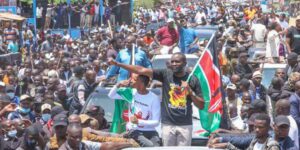
Embattled Edwin Sifuna has rejected claims that he has been receiving political backing from former president Uhuru Kenyatta to mobilise support for the Linda Mwananchi tours.
Speaking during an interview on NTV on Tuesday morning, the Nairobi senator said he has not held any political discussions with the former head of state. He described the online allegations linking him to Kenyatta’s political network as baseless and driven by speculation rather than evidence.
Sifuna pushed back firmly against what he called assumptions that his role as Secretary General of Orange Democratic Movement (ODM) automatically places him within the top decision-making circles of the Azimio coalition. According to him, that line of thinking has created confusion about his political engagements.
“No, I have not had a conversation with him. People expected that because Sifuna is the SG of ODM, he is automatically a member of the council of Azimio. So I do not have information on what is happening in Azimio. You can only ask me questions about what is happening in ODM and Linda Mwananchi,” he said.
Distancing Himself From Azimio Inner Circles
Sifuna made it clear that he does not sit in the core leadership structures of Azimio and therefore cannot speak on coalition-level strategy. His comments signalled an attempt to draw a line between ODM’s internal activities and broader coalition politics.
That clarification matters politically. The Azimio coalition has faced internal tensions since the last general election, with different factions charting separate paths. By stating that he lacks direct knowledge of Azimio’s internal dealings, Sifuna positioned himself strictly within the ODM and Linda Mwananchi framework.
He stressed that his current focus remains on strengthening ODM structures and expanding the reach of the Linda Mwananchi movement. In doing so, he dismissed the narrative that he operates as a proxy for Kenyatta or any other political heavyweight behind the scenes.
Funding of Linda Mwananchi Tours
Sifuna also addressed rumours that the Linda Mwananchi tours receive financial support from Kenyatta’s political machinery. He denied that claim outright and said the movement relies largely on grassroots mobilisation and public goodwill.
“We will give you a breakdown of our expenses in our past campaigns, and before that, we can tell you that we have been largely relying on goodwill and support from the common mwananchi, which we are very happy about,” he stated.
That assertion aims to frame the movement as people-driven rather than elite-funded. However, the burden of proof will rest on transparency. Promising a financial breakdown creates expectations. If that disclosure fails to materialise or lacks detail, critics will intensify scrutiny. Political movements that claim grassroots funding must back it up with verifiable numbers.
Structured Path to 2027
On his presidential ambitions and the broader opposition strategy, Sifuna outlined a long-term plan focused on building a credible challenge to President William Ruto.
He said the immediate goal of the Linda Mwananchi caucus is not to anoint a single flag bearer but to build a formidable opposition force first. According to him, leadership selection must follow a structured, data-driven process rather than personal ambition or backroom deals.
“The issue of settling on the leader and who will lead us against Ruto must be a structured process. We will look at how many votes we can command from our followers. We have a duty of a lifetime to rescue our country, and this should therefore not be about Sifuna,” he said.
That language reflects an awareness of past opposition fragmentation. Kenyan opposition coalitions often collapse under personality clashes and power struggles. Sifuna appears to advocate a numbers-based approach grounded in measurable support.
Multiple Presidential Contenders
In a notable departure from traditional coalition politics, Sifuna argued that the movement should cultivate several strong presidential hopefuls instead of consolidating around one dominant figure early.
“I want us to grow this movement to a point that there are like 10 viable candidates for the presidency so that if they somehow go for one, nine others can be able to vie for the presidency,” he said.
That strategy carries both opportunity and risk. On one hand, nurturing multiple credible leaders can broaden appeal and energise different voting blocs. On the other hand, too many contenders can fracture unity and dilute messaging. Without disciplined coordination, competition inside the coalition could weaken its national standing.
Sifuna’s proposal assumes that internal competition will remain constructive. History suggests that assumption requires strict management. Political egos rarely coexist peacefully without clear rules and binding agreements.
Targeting a Five Million Vote Margin
Sifuna went further by setting a bold electoral benchmark. He argued that defeating President Ruto would require a margin of at least five million votes to demonstrate widespread public dissatisfaction.
“We must beat William Ruto by at least 5 million votes to make it clear that we are tired of his administration. We must be one force against William Ruto,” he said.
That target signals ambition, but it also raises practical questions. Securing a five-million-vote margin demands deep regional penetration, voter registration drives, coalition unity and disciplined messaging. It requires more than rallies. It demands organisational muscle at polling station level.
Without a coherent ground game, data analytics and sustained voter engagement, such a margin remains aspirational. The opposition must convert rhetoric into structure if it intends to reach that scale.
Cautious Approach to United Opposition Talks
On possible collaboration with United Opposition formations, Sifuna downplayed the urgency of immediate alignment. He argued that strategy should guide any cooperation rather than political pressure or symbolism.
That cautious tone suggests the faction wants leverage before entering broader alliances. Joining forces prematurely could weaken bargaining power. However, waiting too long could isolate the movement if other blocs consolidate independently.
The balance between autonomy and coalition-building will define the opposition’s trajectory. Sifuna’s remarks indicate a preference for consolidation within Linda Mwananchi before negotiating from a position of strength.
The Bigger Picture
Sifuna’s interview reflects three clear objectives: distance himself from claims of elite sponsorship, portray Linda Mwananchi as grassroots-driven, and outline a structured roadmap toward a future electoral contest.
Whether that strategy holds depends on execution. Denials alone will not silence critics. Financial transparency, internal discipline and visible grassroots expansion will determine credibility. The opposition space remains fluid, and leadership narratives shift quickly.
For now, Sifuna has drawn a clear line: no direct political coordination with Kenyatta, no reliance on hidden benefactors, and no rushed coalition deals. The next phase will test whether those claims translate into measurable political traction.
About The Author
