 Skip to content

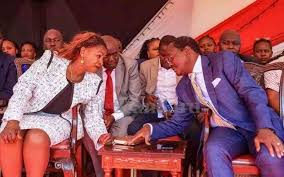
Machakos Governor Wavinya Ndeti has openly endorsed Wiper leader Kalonzo Musyoka for the 2027 presidential election, urging Kenyans to back him on the basis of what she described as his proven track record and long-standing commitment to national leadership.
Speaking at a public function in Machakos, Ndeti framed Kalonzo as a steady, experienced alternative to the current administration, arguing that the country needs a leader who understands governance, constitutionalism, and consensus-building.
Her endorsement is not symbolic; it signals the formal positioning of Kalonzo as a serious contender in what is increasingly shaping up to be a direct contest with President William Ruto.
Ndeti’s backing matters because she is not a peripheral figure. As a sitting governor with control over political machinery in Ukambani, her declaration effectively consolidates the region behind Kalonzo earlier than previous election cycles.
Unlike past elections where Kalonzo hesitated or deferred to coalition partners, the 2027 race is beginning with his home base openly demanding that he runs—and runs to win. That alone marks a strategic shift.
However, the real test for Kalonzo Musyoka is not Ukambani. It is whether he can credibly challenge William Ruto, an incumbent president with state power, an established national party structure, and a narrative built around delivery and continuity.
Kalonzo Musyoka’s Case: Experience Without Executive Footprints
Kalonzo’s strongest selling point is experience. Few politicians in Kenya have his longevity. He has served as Vice President, Cabinet minister, and long-serving legislator.
He has also built a reputation as a moderate, constitutionalist, and consensus-oriented leader. This is the “track record” Wavinya Ndeti refers to institutional memory, diplomacy, and political stability.
But this is also Kalonzo’s biggest weakness.
In Kenyan politics, experience without visible executive output is a hard sell. Kalonzo has never governed a county, never run a ministry with transformative impact, and has no flagship development projects tied directly to his leadership.
Voters increasingly ask a simple question: what did you build, change, or deliver? On that front, Kalonzo struggles to compete with Ruto.
That reality explains why his past presidential ambitions stalled. In 2013, 2017, and 2022, he positioned himself as a principal but stepped aside for coalition politics.
While this earned him the image of a loyal ally, it also entrenched a perception of hesitation and lack of personal ambition for the top job. In 2027, that perception will be weaponised by his opponents.
Ruto’s Advantage: Incumbency and the Politics of “Delivery”
William Ruto enters the 2027 race as the favourite, not because he is universally popular, but because incumbency in Kenya is a powerful weapon.
He controls government machinery, commands national visibility, and will campaign on the argument that projects, reforms, and continuity should not be interrupted.
Ruto’s messaging is simple and brutal: leadership is about delivery, not rhetoric. Roads, housing programmes, infrastructure, and state-backed initiatives form the backbone of his re-election pitch.
Even where these programmes are controversial or unpopular, they exist and existence matters in electoral politics.
That does not mean Ruto is unassailable. His administration faces serious criticism over the cost of living, taxation pressure, unemployment, and public dissatisfaction, especially among the youth.
But dissatisfaction alone does not defeat an incumbent. It must be organised, unified, and converted into votes. That is where the opposition has historically failed.
The Real Question: Can Kalonzo Build a National Coalition?
Wavinya Ndeti’s endorsement strengthens Kalonzo regionally, but it does nothing on its own to solve his national arithmetic problem.
Ukambani votes are not enough to win a presidential election. To defeat Ruto, Kalonzo must build a coalition that cuts across Mt Kenya, Western, Coast, parts of Nyanza, and urban centres.
This is easier said than done.
Opposition politics in Kenya is notoriously fragmented. Every major figure believes they deserve the ticket. Unity is often discussed but rarely institutionalised early enough to matter.
If Kalonzo delays coalition-building or relies on informal goodwill, he will repeat the mistakes of previous opposition bids.
Furthermore, Kalonzo must present more than moral authority and constitutional language. Voters facing economic hardship want concrete plans: jobs, prices, taxes, security.
Without a clear, credible economic and social programme, his campaign risks sounding principled but hollow.
Wavinya Ndeti’s Endorsement: Momentum, Not a Guarantee
Wavinya Ndeti’s endorsement gives Kalonzo momentum, visibility, and early positioning. It also places pressure on him to stop hesitating and fully own the 2027 race.
By publicly backing him, she has effectively closed the door on last-minute withdrawals and coalition compromises that dilute his candidacy.
But endorsements do not win elections. Structures do. Messaging does. Coalitions do.
If Kalonzo fails to expand beyond regional loyalty and does not articulate a sharp, measurable alternative to Ruto’s presidency, his campaign will stall despite early enthusiasm.
On the other hand, if he leverages endorsements like Ndeti’s to build a disciplined national opposition machine, 2027 could become a genuinely competitive race.
The Bottom Line
Wavinya Ndeti’s endorsement marks the clearest signal yet that Kalonzo Musyoka intends to run seriously for president in 2027. It anchors his candidacy at home and forces the national conversation to treat him as more than a perennial coalition partner.
But against William Ruto, symbolism will not be enough. Kalonzo must confront his record honestly, fix his weaknesses, and build a coalition that is real, not rhetorical.
Otherwise, the 2027 contest will remain what it currently is: an incumbent with tangible power versus an experienced challenger still searching for a decisive national breakthrough.
About The Author

