

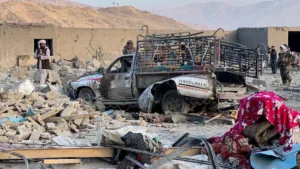
Residents of Kabul’s District 6 woke abruptly on Thursday night after a powerful explosion shook homes. Many rushed into the streets as fighter jets roared overhead in the darkness.
The blast marked a serious escalation between Afghanistan and Pakistan. Pakistan launched airstrikes inside Afghanistan, including in the capital Kabul. (Videos here)
Airstrikes also targeted Paktia and Kandahar provinces during the night. Kandahar remains the birthplace and stronghold of the Taliban movement.
Hostilities between the two neighbors have simmered for months. Each side now blames the other for triggering the latest confrontation.
Earlier that night, Afghanistan’s Taliban government announced a major ground operation. Officials claimed their forces attacked Pakistani military positions near the border.
Taliban authorities said they captured several military posts. They also claimed to have killed and detained Pakistani soldiers during the clashes.
Taliban Calls Operations Retaliatory
Taliban leaders described the ground assault as a retaliatory action. They accused Pakistani military elements of violating Afghan sovereignty.
The Taliban alleged that Pakistani forces carried out incursions into Afghan territory. They further claimed those actions caused civilian deaths, including women and children.
These allegations refer to Pakistani airstrikes conducted less than a week earlier. Those strikes targeted Nangarhar and Paktika provinces on February 21.
The United Nations reported credible information indicating 13 Afghan civilians died in those earlier strikes. The civilian toll has intensified anger within Afghanistan.
Islamabad has rejected accusations of targeting civilians. Pakistani officials insist their air operations focus strictly on militant hideouts.
Pakistan says it specifically targets the Tehreek-i-Taliban Pakistan, also known as TTP. Authorities in Islamabad refer to the group as Fitna al Khawarij.
Pakistani officials claim they hold conclusive evidence linking TTP to recent attacks. They cite the suicide bombing of a Shia mosque in Islamabad as proof.
That bombing killed more than 30 people and shocked the nation. The Islamic State claimed responsibility, yet Pakistan attributes the attack to TTP.
Accusations of Cross-Border Support
Pakistan alleges that TTP leadership operates from Afghan territory. Officials argue that handlers inside Afghanistan coordinate attacks on Pakistani soil.
Islamabad further claims the Taliban government provides indirect support to these militants. Afghan authorities strongly deny these accusations.
The Taliban government maintains that it does not allow its territory to threaten any country. Officials describe Pakistan’s military actions as unprovoked aggression.
The latest exchange follows a serious flare-up in October 2025. During that period, both sides carried out cross-border strikes over several days.
Pakistan launched airstrikes into Afghanistan at that time. Afghan forces responded with artillery and ground operations near border areas.
Qatar and Turkey intervened to mediate between the two governments. Diplomats organized talks in Doha and Istanbul to ease tensions.
A fragile ceasefire followed those negotiations. However, the agreement failed to deliver lasting peace or reduce hostility.
Both governments later accused the other of undermining diplomacy. Distrust deepened, and border tensions continued to simmer.
Military Balance Favors Pakistan
From a military perspective, Pakistan holds significant advantages. The country maintains a large and well-equipped armed force.
Pakistan operates hundreds of tanks and combat aircraft. It also possesses advanced defense technology and surveillance systems.
Afghanistan’s Taliban government relies heavily on equipment left behind after foreign troop withdrawals. Reports suggest the Taliban has acquired additional equipment through informal markets.
Despite sanctions, the Taliban continues to strengthen its security apparatus. However, it lacks the advanced capabilities available to Pakistan.
The renewed fighting places civilians at immediate risk. Explosions and airstrikes in populated areas increase fears of further casualties.
Residents in Kabul and border provinces face uncertainty and anxiety. Many fear prolonged conflict could disrupt daily life and economic stability.
Regional stability also hangs in the balance. Escalation between the two neighbors could draw international attention and diplomatic pressure.
Global actors may push for renewed negotiations to prevent broader instability. Continued violence risks undermining fragile security gains in the region.
Diplomatic Prospects Remain Uncertain
Diplomatic channels remain open but strained. Both governments continue issuing statements defending their positions.
Observers believe meaningful dialogue will require confidence-building measures. Without trust, ceasefires may remain temporary and fragile.
International mediators could re-engage to de-escalate tensions. However, success will depend on political will from both capitals.
The dispute between Afghanistan and Pakistan has deep historical roots. Border tensions and militant activity have fueled mistrust for decades.
Each government accuses the other of harboring hostile elements. These competing narratives complicate efforts to achieve lasting peace.
The latest airstrikes and ground operations illustrate how quickly tensions can intensify. Even minor incidents along the border can spiral into wider confrontations.
Uncertain Path Forward
As jets fly and artillery echoes, both nations face critical choices. Leaders must weigh military actions against diplomatic solutions.
Continued escalation could deepen regional instability. Constructive engagement offers the only realistic path toward reducing violence.
For now, Kabul residents remain on edge after a night of explosions. The coming days will determine whether this confrontation expands or gives way to renewed talks.
About The Author
