 Skip to content

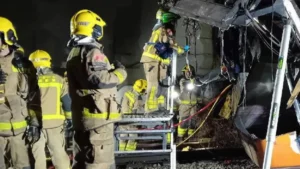
A deadly commuter rail accident near Barcelona has deepened Spain’s growing transport safety crisis, killing a train driver and injuring dozens of passengers only days after another catastrophic rail collision in the south. The derailment occurred on Tuesday evening on the Rodalies commuter network, intensifying national concern about rail safety and infrastructure resilience.
Regional authorities said the train crashed after hitting a retaining wall that had collapsed onto the tracks between Gelida and Sant Sadurní. The collision forced the train off the rails, killing the driver instantly and injuring at least 37 passengers, five of them seriously.
Emergency services were dispatched immediately as violent storms swept across north-eastern Spain, worsening already dangerous conditions. Firefighters, paramedics, and police struggled through heavy rain and strong winds to reach the wreckage and begin rescue operations.
Catalonia’s regional fire inspector, Claudi Gallardo, confirmed that all passengers were eventually evacuated from the damaged train. He said rescue teams worked systematically to ensure no one remained trapped, despite the instability of the site.
Storm conditions complicate rescue and response efforts
The accident occurred amid intense storms battering large areas of Catalonia and surrounding regions. Weather authorities had already placed coastal and inland zones on high alert due to heavy rainfall and strong winds.
Emergency medical services deployed at least eleven ambulances to the scene in Gelida, located about thirty-five kilometers west of Barcelona. The injured were treated on site before those in critical condition were rushed to nearby hospitals.
The Catalan fire service said thirty-five rescue crews were mobilized to manage the emergency response.
Their duties included stabilizing the derailed train, rescuing trapped passengers, clearing debris, and securing the area.
One passenger was initially trapped inside the wreckage and required specialized extraction by firefighters. Officials later confirmed the passenger survived and was transferred to hospital for further treatment.
Meteorologists warned that saturated soil and weakened infrastructure increased the risk of landslides and collapsing structures. Those warnings now appear directly linked to the cause of the derailment.
Second derailment raises alarm over rail safety
Earlier the same day, another train on the Barcelona commuter network also derailed, adding to public alarm. Spain’s rail network operator Adif said the derailment occurred after a rock dislodged by storm conditions struck the train’s axle.
The affected service was running between Blanes and Maçanet-Massanes, north-east of Barcelona. Rail officials said no injuries were reported in that incident, but services were immediately suspended.
Engineers were dispatched to inspect the tracks and surrounding terrain for further risks. Passengers experienced widespread delays as authorities prioritized safety over restoring operations.
The back-to-back derailments highlighted the vulnerability of rail infrastructure during extreme weather. Critics argue that climate-related risks are outpacing maintenance and monitoring efforts.
Rail unions have renewed calls for better protection for drivers and frontline staff. They warn that workers are increasingly exposed to life-threatening situations during severe weather events.
National scrutiny after multiple rail disasters
The Catalonia incidents came just two days after one of Spain’s worst rail disasters in over a decade. On Sunday, two high-speed trains collided in Adamuz, Andalusia, killing at least forty-two people.
That crash occurred when a Madrid-bound train derailed, crossed onto the opposite tracks, and struck an oncoming high-speed train. The scale of the disaster shocked the nation and triggered intense scrutiny of rail safety systems.
Transport experts say Spain’s rail network faces growing pressure from aging infrastructure and extreme weather patterns. They argue that retaining walls, embankments, and trackside monitoring systems require urgent upgrades.
Spanish transport authorities have promised full investigations into all recent rail accidents. Independent experts will assess whether infrastructure failures, operational decisions, or ignored warnings played a role.
For now, services remain disrupted, investigations continue, and public confidence has been shaken. The deadly derailment near Barcelona has become another warning that Spain’s rail safety system is under serious strain.
About The Author

