 Skip to content

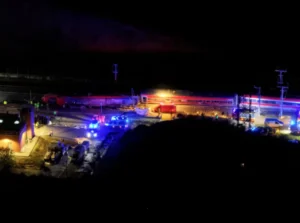
A devastating rail disaster struck southern Spain on Sunday evening after a high-speed passenger train derailed and slammed into another oncoming train, killing at least 21 people and injuring dozens more in one of the country’s deadliest transport accidents in recent years.
The collision occurred near Adamuz, a small town in Córdoba province, roughly 360 kilometres south of Madrid. According to Spain’s Interior Ministry, the first train, operated by private rail company Iryo and travelling from Málaga to Madrid, derailed at high speed before crashing onto an adjacent track.
Moments later, it struck a Renfe-operated train heading from Madrid to Huelva, forcing the second train off the rails and down a steep embankment.
Emergency officials said the impact was catastrophic.
Of the 75 passengers hospitalised, at least 15 remain in serious condition, Andalusia regional president Juanma Moreno told reporters in the early hours of Monday. He warned that the death toll was likely to rise as rescue teams continued to search through mangled wreckage.
“The force of the accident was extremely strong,” Moreno said. “Heavy machinery is required to remove the twisted metal, and it is possible more bodies will be found as daylight operations continue.”
The crash happened at approximately 7:45 p.m., about 10 minutes after the Iryo train departed Córdoba en route to Madrid.
Rail network operator Adif confirmed that the derailed Iryo train crossed onto the adjacent line, directly into the path of the Renfe Alvia service travelling at around 200 kilometres per hour.
Most of the fatalities and severe injuries were reported in the first two carriages of the Renfe train, which plunged down the embankment after impact. Transport Minister Óscar Puente said the lead carriage carried 37 passengers, while the second had 16, making them especially vulnerable during the collision.
The Iryo train was carrying more than 300 passengers, while the Renfe service had around 100 on board. In total, close to 400 people were involved in the crash. Most were Spanish nationals returning to or leaving Madrid after the weekend, although officials said it remained unclear how many foreign travellers were among them.
Footage shared on social media showed a grim rescue operation unfolding under floodlights. Emergency crews pulled injured passengers from overturned and crushed carriages, while others escaped through shattered windows. Several victims were wheeled away on stretchers as firefighters and paramedics worked in tight, unstable spaces.
“There were people screaming. Bags fell from the shelves,” one passenger on the Renfe train told public broadcaster TVE. “I was in the fourth carriage, the last one. Luckily, I survived.”
Another survivor, María San José, who was travelling on the Málaga-to-Madrid Iryo service, described the aftermath as terrifying. “There are many injured. I am still trembling,” she told El País newspaper.
El País also reported that the 27-year-old driver of the Renfe Madrid-to-Huelva train was among those killed.
Rescue operations proved particularly challenging inside the Renfe carriages, which suffered the worst structural damage. Córdoba fire chief Paco Carmona said twisted metal and collapsed seating made access extremely difficult.
“There are still people trapped,” he told TVE. “The work is now focused on very narrow areas. In some cases, bodies must be removed to reach anyone who may still be alive. It is an extremely complex operation.”
Adamuz Mayor Rafael Moreno, who arrived at the scene shortly after the crash, described the devastation in stark terms. He said he saw what appeared to be a badly lacerated body several metres from the tracks.
“The scene is horrific,” he said. “Right now, the priority for local authorities and residents is helping the passengers.”
A temporary reception centre was set up in Adamuz, a town of around 5,000 residents. Local people brought food, water, and blankets for survivors as temperatures dropped to about 6 degrees Celsius overnight. Tearful passengers were later transported by bus and escorted inside for assistance.
Spanish Prime Minister Pedro Sánchez described the tragedy as a moment of national mourning. “Tonight is a night of deep pain for our country,” he said in a message posted on X. A spokesperson for Spain’s King and Queen said the royal family was closely following developments.
Despite the scale of the disaster, the cause of the derailment remains unknown. Transport Minister Puente said it was “really strange” for a train to derail on a straight section of track, noting that the line had undergone renewal works as recently as May.
Iryo, which is majority-owned by Italian state-controlled railway group Ferrovie dello Stato, said it deeply regretted the incident and had activated all emergency protocols. Renfe confirmed that its derailment occurred after the Iryo train entered its path and said its president was travelling to the crash site to oversee response efforts.
Adif has suspended all rail services between Madrid and Andalusia as investigators begin examining one of the most serious rail accidents Spain has faced in decades.
About The Author

