

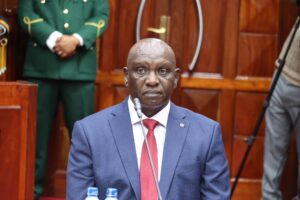
Inspector General of Police Douglas Kanja has been spared a custodial sentence after the High Court found him in contempt over police roadblocks erected in Nairobi. Justice Patricia Nyaundi instead issued a stern warning after Kanja personally appeared in court and committed to ensuring future compliance with judicial orders.
Kanja Makes Personal Undertaking
The police chief appeared before Justice Nyaundi accompanied by senior officers from the National Police Service. His appearance followed the earlier finding that he had failed to ensure compliance with an order requiring public notice before emergency road barricades and checkpoints were established.
The judge said Kanja had demonstrated how the order would be implemented within the police service. His assurance that the directives would be communicated to officers was considered before the court decided against imposing a punitive sentence.
Justice Nyaundi warned that the decision should not be interpreted as permission for similar conduct in the future. She said a repeat violation could lead to the consideration of a custodial sentence against the Inspector General.
Court Case Followed June Roadblocks
The contempt proceedings arose from police roadblocks mounted across Nairobi during the June 25, 2026 demonstrations. The High Court had previously required police to issue timely public advisories before closing roads, erecting barricades or establishing checkpoints.
Justice Nyaundi had earlier found that the required advisory was not issued before the roads were barricaded. The court held Kanja responsible for failing to ensure that officers under his command complied with the existing order.
The original order had been issued by Justice Lawrence Mugambi in July 2025. It restricted the police from blocking access to Nairobi’s central business district and other public roads without giving members of the public sufficient notice.
Freedom of Movement Considered
Justice Nyaundi said the case involved more than the regulation of demonstrations under Article 37 of the Constitution. Questions concerning freedom of movement under Article 39 and the constitutional responsibilities of the National Police Service were also considered.
The court further linked the matter to constitutional principles under Articles 10 and 244. The provisions require public institutions and the police service to uphold constitutional values, the rule of law and their responsibilities to the public.
The court had previously rejected arguments that operational police procedures could excuse non-compliance with the binding order. The requirement to issue an advisory before emergency barricading was treated as an obligation that had to be observed.
Kanja Warned of Tougher Action
While sparing Kanja from punishment on this occasion, Justice Nyaundi made clear that future non-compliance would be treated differently. The court warned that another violation could result in a custodial sentence being considered.
Kanja’s personal attendance and undertaking were therefore central to the outcome of the sentencing proceedings. The National Police Service is now expected to ensure that officers follow the court’s directions whenever similar road restrictions are imposed.
The latest decision closes the immediate sentencing phase of the contempt proceedings while placing the police leadership under a clear warning regarding future compliance. The court’s position also reinforces the requirement that restrictions affecting public movement must be implemented in accordance with existing judicial orders.
About The Author
