

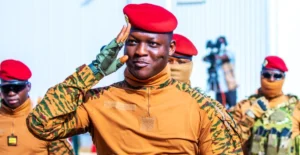
Burkina Faso’s military government claims it thwarted a plot to kill President Captain Ibrahim Traoré. The plot allegedly involved former leader Paul-Henri Damiba, whom Traoré ousted in a 2022 coup. The country’s security minister, Mahamadou Sana, stated that the plot was coordinated from Ivory Coast.
Details of the Foiled Plot
On January 6, 2026, the government revealed it foiled an assassination attempt targeting President Traoré. Sana claimed the plan involved military officers and former allies of Damiba. The goal was to eliminate Traoré and destabilize the country. Sana further alleged that Ivory Coast funded the plot, though no confirmation has come from Abidjan.
The coup plot adds to the mounting tensions in Burkina Faso since Traoré’s rise to power. This is not the first assassination attempt Traoré has faced. Traoré has managed to survive multiple coup attempts since his 2022 coup. The government insists that the foiled assassination was one of the most dangerous attempts.
The Political Background of the Conflict
Captain Ibrahim Traoré took power on September 30, 2022, after ousting Paul-Henri Damiba. Damiba had led a coup earlier in the year, overthrowing President Roch Marc Christian Kaboré. Damiba’s rule was marked by a failure to curb jihadist violence. Traoré and his supporters cited this failure as the reason for Damiba’s removal.
The political instability in Burkina Faso has worsened since Traoré’s rise. Traoré has faced accusations of authoritarian rule and human rights violations. However, he maintains that the military government is necessary to address ongoing insurgent threats.
Ivory Coast’s Alleged Role in the Plot
One shocking element of the plot is Ivory Coast’s alleged involvement. The Burkinabe government claims the assassination was funded from Ivory Coast’s capital, Abidjan. Sana has not provided further details about how Ivory Coast coordinated the plot. Ivory Coast has yet to issue an official response to the claims.
While no proof has emerged, the Burkinabe government’s allegations point to external involvement. Some believe Ivory Coast may have interests in influencing Burkina Faso’s political future. The country’s leadership has often accused foreign governments of meddling in its internal affairs.
Traoré’s Struggles to Maintain Power
Traoré’s leadership has been under constant threat since his 2022 coup. Burkina Faso remains engulfed by Islamist insurgencies that threaten its security. Despite efforts to stabilize the country, security conditions continue to worsen. Traoré has struggled to gain control over vast areas of the country.
There have been multiple coup attempts against Traoré, which reflect divisions within the military elite. These internal rivalries highlight the fragile nature of his government. Some factions within the military reportedly seek to displace Traoré, leading to further instability.
The Sahel’s Ongoing Instability
Burkina Faso’s troubles are part of a larger pattern of instability in the Sahel region. Other countries, such as Mali and Niger, have experienced similar military coups. The region’s growing insecurity is mainly due to escalating jihadist violence. Governments in the Sahel have struggled to effectively combat these groups.
In the past few years, the number of coups in the region has risen sharply. The growing trend of military governments replacing civilian rule complicates international efforts to stabilize the Sahel. Burkina Faso’s military junta has been particularly outspoken in blaming external powers for its instability.
Ivory Coast’s Silence on the Matter
Despite the serious allegations, Ivory Coast has remained silent on the matter. No official statement has been released regarding the plot or the accusations from Burkina Faso. Some experts speculate that the silence indicates either a lack of involvement or strategic ambiguity.
The lack of comment from Ivory Coast leaves the allegations hanging. This silence is likely to fuel further speculation and diplomatic tension between the two countries. As tensions rise, both nations may face challenges in managing their bilateral relations.
Conclusion: A Fragile Future for Burkina Faso
Burkina Faso’s military government faces enormous challenges as it tries to stabilize the country. The foiled assassination plot is one of the most significant incidents in recent months. The accusations against Ivory Coast add a new dimension to the political instability.
The ongoing insurgency, coupled with political rivalries, makes the future of Burkina Faso uncertain. Whether Traoré can maintain control or will face further challenges remains unclear. The political landscape in Burkina Faso is fragile, and the risk of more coups or violence is high.
Burkina Faso’s military government will need to act decisively to prevent further unrest. The situation in the Sahel continues to deteriorate, with no clear end in sight. With rivalries within the military and jihadist violence escalating, the country’s future remains uncertain.
About The Author
