

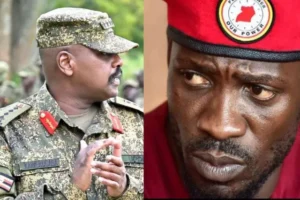
Uganda’s Chief of Defence Forces Muhoozi Kainerugaba issued a controversial declaration targeting opposition leader Robert Kyagulanyi publicly nationwide. In a social media statement Muhoozi claimed he had banned Bobi Wine from elections entirely.
He argued the decision served national security interests and protected what he termed Uganda’s broader commonwealth. The declaration immediately triggered public outrage because a serving military chief lacks constitutional authority over elections.
Critics questioned how a uniformed officer could lawfully restrict political participation in a civilian democratic process. Muhoozi framed his remarks as personal opinions despite repeatedly invoking his position as Chief of Defence Forces.
Earlier the same week Muhoozi issued a forty eight hour ultimatum demanding Bobi Wine surrender to police. He warned that failure to comply would result in Wine being treated as an outlaw rebel.
The ultimatum alarmed human rights groups who described it as intimidation and an abuse of state power. Muhoozi further claimed his actions did not involve President Yoweri Museveni despite being his son.
He stated publicly that he exonerated his father from responsibility for consequences facing Bobi Wine. These remarks intensified debate about dynastic politics and military influence within Uganda’s political system.
Bobi Wine responded swiftly rejecting the ultimatum and accusing security forces of targeting him violently. He said soldiers and police raided his home in Magere during the night unlawfully.
Wine claimed he escaped capture and dismissed official statements denying any attempt to arrest him.
He argued Muhoozi’s ultimatum contradicted earlier claims that authorities were not pursuing him.
In his response Wine accused the security establishment of committing atrocities against ordinary Ugandans.
He said intimidation arrests and violence had become routine tools used to silence dissent nationwide. Wine insisted he would resurface on his own terms refusing to surrender under threats.
He warned Muhoozi and Museveni that accountability for alleged abuses would eventually arrive inevitably. The exchange heightened fears among supporters who worried Wine might be forcibly detained or harmed.
Reports circulated widely after Wine disappeared temporarily raising concerns about enforced disappearance again. Wine later reassured supporters saying he was safe but under constant threat from state agents.
The confrontation follows Uganda’s recent presidential election held amid heavy security deployment nationwide. President Museveni was declared winner securing seventy two percent of the vote officially.
Bobi Wine finished second with twenty five percent according to the Electoral Commission results. Wine rejected the outcome alleging widespread rigging ballot stuffing and manipulation across polling stations.
He claimed turnout figures exceeded registered voters even at Museveni’s own polling station. Wine shared videos allegedly showing officials marking ballots in Museveni’s favour unlawfully.
Authorities dismissed the allegations maintaining the election was free fair and credible overall. International observers however noted irregularities including internet shutdowns arrests and excessive force.
Museveni has ruled Uganda for four decades maintaining power through elections criticised repeatedly. Muhoozi’s statements renewed scrutiny on succession politics and militarisation of Uganda’s governance.
Analysts warned such remarks undermine civilian rule and constitutional separation between army and politics. Opposition leaders accused the military of openly siding with the ruling establishment politically.
Civil society groups urged restraint and demanded respect for democratic rights constitutional freedoms immediately. They warned that threats against opposition leaders could destabilise the country significantly.
The situation reflects deeper tensions within Uganda’s political landscape ahead of future elections. Many Ugandans fear shrinking democratic space and increased repression under security justification narratives.
Calls grew for regional and international actors to press Uganda on democratic accountability urgently. The standoff continues drawing attention to the role of security institutions in civilian governance.
Observers caution that unresolved tensions could escalate unless dialogue and constitutionalism prevail nationally. Uganda now faces renewed scrutiny over civil liberties political tolerance and rule of law.
About The Author
