
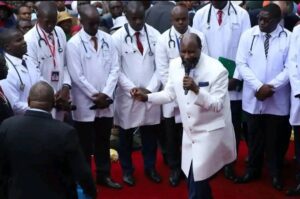
Controversial Kenyan preacher Prophet David Owuor has claimed he predicted a United States military intervention in Venezuela months before it occurred. The claim has stirred renewed debate about prophecy, politics, and credibility.
According to Owuor, the revelation came through a prophetic dream he allegedly received on November 16, 2025. He says the dream occurred one day before his departure from Venezuela on November 17.
Video footage circulating online captures Owuor describing the vision in detail. In the recording, he presents the dream as a divine warning involving former U.S. President Donald Trump.
The preacher insists the prophecy was shared publicly before recent developments in Venezuela. Supporters have cited the timing as evidence supporting his claim. Critics, however, remain unconvinced and question the interpretation and verification of the prophecy.
Details of the Alleged Prophetic Vision
During the recorded briefing, Owuor describes seeing Donald Trump clearing land inside Venezuela. He interprets this action as symbolic of American control and territorial dominance.
Owuor further claims he saw Trump park the official U.S. presidential limousine inside the country. He referred to the vehicle as “the beast,” a term commonly associated with the U.S. presidency.
According to the preacher, Trump declared that development could begin after clearing the land. Owuor said the scene symbolised the start of American influence over Venezuelan territory.
He framed the imagery as a clear indication of foreign military intervention. In his account, the dream carried no ambiguity about its geopolitical meaning.
The preacher presented the vision as a warning rather than a political endorsement. He insisted the message focused on divine revelation rather than political alignment.
Sharing the Prophecy Before Leaving Venezuela
Owuor claims he shared the prophecy with Venezuelan authorities before leaving the country. He also says senior church leaders and media personalities received the warning.
According to him, the disclosure occurred during meetings held in Caracas. He maintains that the message was communicated openly and without secrecy.
Owuor insists the prophecy was documented and discussed before later developments. He argues this timing supports the authenticity of his claim.
No independent authority has confirmed whether officials formally acknowledged the prophecy. The lack of verification has fueled scepticism among critics and analysts.
Despite this, supporters continue to circulate the footage as evidence of foresight. They argue that prophetic symbolism often precedes real-world events.
Arrest of President Nicolás Maduro and Public Reaction
The claim gained widespread attention after U.S. forces detained Venezuelan President Nicolás Maduro. The detention reportedly occurred in early January 2026.
Observers quickly linked the event to Owuor’s earlier statements. Supporters described the development as fulfilment of the prophecy.
The situation created sharp contrast with Owuor’s earlier actions in Venezuela. During a December 2025 visit, he publicly prayed for Maduro’s protection.
In the same visit, Owuor urged Venezuela to pursue national repentance. He said the country faced divine judgment and needed spiritual renewal.
The eventual capture of Maduro raised questions about the prayer’s outcome. Critics questioned how divine protection aligned with the detention.
Supporters countered that prophecy does not always prevent events. They argued that warnings reveal outcomes rather than change them.
Honors, Influence, and Growing Controversy
Before his detention, Maduro awarded Owuor the Presidential Medal of Honor. The award recognised Owuor’s spiritual activities in Latin America.
The honor elevated Owuor’s profile within international religious circles. It also intensified scrutiny following later political developments.
Critics argued the award blurred boundaries between religious leadership and state authority. Others viewed it as recognition of spiritual outreach rather than political alignment.
The contrast between the honor and subsequent detention drew sharp commentary. Some accused Owuor of misinterpreting events after the fact.
Others argued global politics often unfold unpredictably despite spiritual interventions. The debate highlighted divisions between belief and evidence.
Biblical Interpretation and Global Conflict Narrative
Owuor linked the alleged prophecy to biblical scripture. He cited Matthew 24:7, which references wars between nations and kingdoms.
According to him, the verse supports warnings of escalating global conflict. He argued modern geopolitical tensions mirror biblical prophecy.
Religious scholars remain divided on such interpretations. Some caution against applying scripture directly to political events.
Others note that biblical passages often carry symbolic meaning. They warn against using prophecy to predict specific geopolitical outcomes.
The debate reflects broader tensions between faith-based interpretation and political analysis. It also underscores the influence of religious narratives in times of uncertainty.
Mounting Scrutiny in Kenya Over Healing Claims
The Venezuelan prophecy emerges amid growing scrutiny of Owuor in Kenya. The Kenya Medical Practitioners and Dentists Council has launched investigations into healing claims.
Authorities are examining whether alleged miracle healings received medical verification. Health officials have raised concerns about unproven medical claims.
Health Cabinet Secretary Aden Duale reportedly warned of possible consequences. He stated that clergy and doctors could face action without scientific evidence.
Owuor’s Ministry of Repentance and Holiness has rejected the accusations. The ministry demanded a formal audit of all documented healing testimonies.
It also threatened legal action against media organisations it accuses of distortion. The ministry insists healings occurred through divine intervention.
Medical experts have expressed concern about public health risks. They warn patients may abandon treatment after hearing miracle testimonies.
Credibility, Belief, and Public Debate
The prophecy claim has intensified debate about Owuor’s credibility. Supporters view him as divinely guided and spiritually authoritative.
Critics argue the prophecy lacks independent verification. They question whether the imagery reflects foresight or coincidence.
Political analysts note that U.S.–Venezuela tensions predate the alleged prophecy. They argue military planning rarely occurs without long-term indicators.
Security experts emphasise that global interventions involve extended preparation. They caution against attributing such events to singular prophetic moments.
Despite scepticism, Owuor’s influence remains significant among followers. His messages continue to attract attention and loyalty.
The episode highlights the intersection of religion, politics, and public perception. Faith leaders increasingly shape narratives during global crises.
Whether the prophecy strengthens or weakens Owuor’s standing remains uncertain. What is clear is that the debate surrounding his claims will persist.
About The Author
