
As factions multiply, ODM drifts without a unifying leader
ODM once moved with discipline because one voice settled disputes. That voice no longer commands daily obedience. Leaders now speak freely and often contradict each other. Authority has become symbolic rather than operational.
This shift did not happen overnight or by accident. It followed years of postponed succession planning. Raila Odinga’s presence once ended arguments instantly. His distance now invites constant negotiation.
Negotiation sounds democratic but weakens command structures. Parties require decisions, not endless consultations. ODM still fills stadiums and commands headlines. Crowds, however, do not equal control.
A movement without a center invites centrifugal forces. Each ambitious actor pulls toward personal survival. That is how drift begins in political parties. It starts quietly and spreads fast.
How leadership vacuum and internal rivalries are hollowing out the party
Vacuum creates competition because space attracts ambition. ODM currently offers too much space. Senior figures test limits without consequences. Silence from the top emboldens risk-taking.
Governors now act like regional party owners. National cohesion has weakened significantly. MPs hedge their futures with cautious statements. Loyalty has become conditional and transactional.
Youth leaders shout slogans without strategic grounding. Energy replaces clarity in public messaging. Internal rivalries now shape public behavior. Leaders position themselves rather than the party.
Every interview feels like an audition. No one speaks with final authority. This pattern signals hollowing, not renewal. Institutions weaken when personalities dominate unchecked.
Why ODM’s power base is moving — and no one is in charge
Power rarely disappears; it relocates strategically. ODM’s power base is quietly shifting. Some leaders flirt with the ruling establishment. Others cultivate independent regional alliances.
Few openly defect because optics still matter. Many reposition silently to protect relevance. This is not betrayal; it is rational behavior. Politics punishes uncertainty harshly.
Members sense unclear direction and seek insurance. Insurance often comes from alternative power centers. The party cannot stop this without command clarity. Discipline flows from certainty, not nostalgia.
ODM still controls key counties and voting blocs. Control without coordination produces diminishing returns. Voters notice confusion faster than politicians admit. Confusion erodes trust steadily.
An exodus that happens without defections
Exodus does not always involve resignation letters. It often begins in the mind. Attendance declines at strategic meetings. Engagement weakens behind closed doors.
Messaging discipline fades across platforms. Leaders improvise rather than align. Parallel strategies emerge without coordination. Each faction claims to protect the party.
Psychological exit precedes physical exit. History confirms this pattern repeatedly. The party house still looks occupied. Many rooms, however, stand emotionally empty.
This silent migration weakens institutions faster. Noise hides decay but cannot stop it. ODM now faces this quiet erosion. Denial only accelerates the process.
Succession postponed is succession denied
ODM avoided hard succession conversations for years. Loyalty replaced institutional planning. That decision delivered short-term unity. It now produces long-term instability.
No clear process exists for leadership transition. Ambiguity invites conflict by default. Potential successors test strength publicly. The party lacks rules to contain ambition.
Strong parties institutionalize leadership renewal. ODM personalized authority instead. Personalized systems struggle after the center weakens. The result is predictable chaos.
Succession denial now shapes every internal dispute. Each disagreement carries future stakes. Until addressed, tension will intensify. Time will not solve this alone.
Multiple voices, zero command
ODM leaders speak daily across media platforms. Messages rarely align consistently. Some call for confrontation while others preach accommodation. Voters receive mixed signals.
Mixed signals erode credibility quickly. Clarity builds trust; confusion destroys it. Command does not silence debate permanently. It ends debate decisively.
ODM currently debates without conclusion. Conclusions require recognized authority. Without command, strategy becomes optional. Optional strategy produces optional loyalty.
Opponents exploit this weakness silently. They let ODM argue publicly. Silence from rivals is strategic patience. Confusion often defeats opposition naturally.
Rivals do not need to fight a divided opposition
The ruling side watches without urgency. Internal ODM conflict does their work. Attacks are unnecessary when drift exists. Drift drains momentum independently.
A fractured opposition struggles to coordinate resistance. Fragmentation weakens negotiation power. ODM once forced national conversations. It now reacts to them.
Reactivity signals loss of initiative. Initiative defines effective opposition. Without unified command, ODM cannot set agenda. Agenda-setting requires discipline.
Rivals benefit from delayed ODM decisions. Delay creates missed opportunities. Political space never remains empty. Others will fill it.
The myth of numbers without structure
ODM supporters remain numerous nationwide. Numbers alone cannot substitute leadership. Crowds mobilize emotion, not strategy. Strategy demands organization and clarity.
History shows movements fail despite popularity. Structure determines endurance. ODM risks confusing visibility with strength. Visibility fades without coherence.
Social media amplifies noise, not command. Trends do not equal direction. The party must choose between spectacle and structure. Both rarely coexist naturally.
Successful parties prioritize internal order. ODM currently prioritizes public presence. Presence without order weakens negotiating power. Power demands internal discipline.
From unity to managed ambiguity
ODM once enforced internal discipline aggressively. Ambiguity now replaces enforcement. Leaders exploit ambiguity to test limits. Testing becomes routine when unchecked.
Routine testing erodes respect for institutions. Institutions rely on predictability. Predictability comes from rules and enforcement. ODM enforces little today.
This shift feels inclusive but weak. Inclusion without boundaries breeds chaos. The party confuses tolerance with strength. Strength requires limits.
Managed ambiguity may delay conflict briefly. It cannot prevent eventual confrontation. That confrontation will arrive unplanned. Unplanned conflict favors opportunists.
Why Kenyans still smile knowingly
Kenyans have seen this cycle before. Parties rise around personalities then stall. Smiles come from recognition, not mockery. Familiar patterns inspire cynical humor.
Political amnesia repeats identical mistakes. ODM now risks repeating them. Voters understand power dynamics intuitively. They read signals beyond speeches.
They sense leadership hesitation immediately. Hesitation reduces confidence. Confidence shapes turnout and loyalty. Doubt suppresses both quietly.
Kenyans smile because predictability comforts them. They know how this story unfolds. They wait for correction or collapse. Both outcomes remain possible.
Time exists, but leadership determines its value
ODM still has time to correct course. Time alone, however, solves nothing. Leadership must assert command clearly. That command must feel legitimate.
Legitimacy flows from process and authority. Neither can remain ambiguous. The party needs defined leadership pathways. Defined paths reduce destructive competition.
Clear command would stabilize messaging quickly. Stability restores negotiating power. Without action, drift will harden into fragmentation. Fragmentation resists reversal.
History offers no mercy to indecision. Politics rewards clarity ruthlessly. ODM must choose decisively or drift publicly.
Who leads without borrowing yesterday’s authority
The core question remains unresolved. Who leads without inherited legitimacy? Borrowed authority fades quickly. Earned authority requires structure.
Leadership today demands institutional backing. Personality alone no longer suffices. ODM must confront this reality honestly. Delay increases future costs.
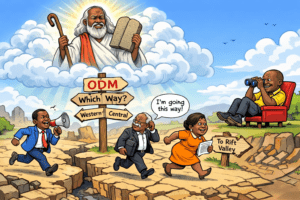
The party stands at an inflection point. Choices made now will define relevance. An exodus without Moses is not destiny. It is a warning.
Warnings demand response, not nostalgia. Nostalgia comforts but solves nothing. The journey continues regardless of leadership choices. Direction depends on courage now.
About The Author
