 Skip to content

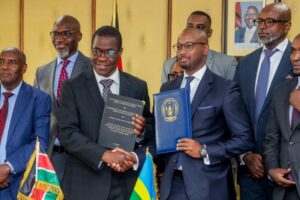
Kenya and Rwanda have strengthened their trade partnership after signing three agreements to facilitate bulk petroleum imports through the Port of Mombasa. The new framework will allow Rwanda to purchase refined fuel under a Government-to-Government (G2G) arrangement and transport it through the Northern Corridor.
Officials from both countries signed the agreements on Monday, June 29, at KASNEB Tower in Nairobi. The package includes a Memorandum of Understanding, a Tripartite Agreement and a Transport and Storage Agreement.
Deal Opens New Chapter
Negotiators from Kenya and Rwanda began discussions during a bilateral meeting in Kigali in November 2024. Kenya’s Cabinet later approved the framework on June 16, 2026, allowing both countries to finalize the agreement.
The new arrangement gives Rwanda direct access to Kenya’s fuel import system through the Port of Mombasa. It also strengthens the Northern Corridor as the preferred route for petroleum products destined for Rwanda.
Government projections show Rwanda imported about 42,000 cubic metres of petroleum through the corridor during 2025. Officials now expect annual volumes to exceed 500,000 cubic metres under the new arrangement.
The first cargo under the agreement will reach the Port of Mombasa between September 4 and September 6, 2026. Authorities have already assigned the shipment the reference number RNEC 001/2026.
Wandayi Promises Reliable Supply
Energy Cabinet Secretary Opiyo Wandayi described the agreements as more than commercial documents between two neighbouring countries. He said Kenya has committed itself to guaranteeing Rwanda a secure and reliable fuel supply for many years.
Wandayi noted that Kenya will provide a predictable transit environment for petroleum products moving to Rwanda. He added that the agreement reflects the confidence both governments have built through years of cooperation.
The CS said the expected increase in fuel volumes marks only one benefit of the partnership. He explained that the agreement will deepen economic integration across the East African Community and the wider Great Lakes region.
According to Wandayi, stronger regional trade will encourage more investment in transport and energy infrastructure. He said both countries stand to benefit from increased business activity along the Northern Corridor.
Rwanda Welcomes Agreement
Rwanda’s Minister for Trade and Industry Antoine-Marie Kajangwe welcomed the agreements as a major milestone for his country’s energy sector. He said Rwanda has worked closely with Kenya to establish a reliable petroleum supply framework.
Kajangwe said the partnership will guarantee stable access to affordable petroleum products for Rwanda. He added that trust between the two governments made the agreement possible.
The minister also expressed optimism ahead of the first fuel shipment scheduled for September. He said Rwanda expects the arrangement to strengthen economic cooperation between the two neighbouring countries.
KPC Eyes Bigger Market
Kenya Pipeline Company Acting Managing Director Pius Mwendwa praised the agreement after years of market expansion efforts. He said KPC had pursued Rwanda’s petroleum market through different strategies for more than a decade.
Mwendwa noted that Kenya previously supplied less than ten percent of Rwanda’s fuel requirements. He expressed confidence that the new framework will significantly increase Kenya’s market share.
He also said higher fuel volumes will improve the utilisation of Kenya’s petroleum infrastructure. Increased throughput will strengthen the country’s position as a regional fuel distribution hub.
Regional Trade Expected to Grow
The agreement further reinforces the strategic importance of the Port of Mombasa for regional trade. It also positions Kenya as a critical gateway for petroleum supplies destined for landlocked East African countries.
Officials from both governments expressed confidence that the partnership will deliver long-term economic benefits. They said stronger cooperation in the energy sector will support regional integration while improving fuel security across the region.
About The Author

