

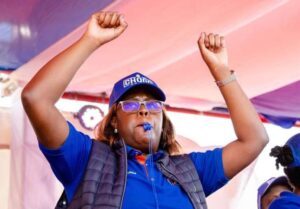
EALA MP Winnie Odinga has launched a blunt and uncompromising attack on a section of Orange Democratic Movement leaders whom she accuses of pursuing selfish political interests. She argues that these individuals are deliberately working to sideline her from the party’s internal decision-making structures. Winnie made it clear that she has no intention of remaining quiet when she believes the party is heading in the wrong direction.
Speaking at a charged political rally in Kibra, Nairobi, on Sunday, Winnie said she fully understands the resistance she faces within ODM circles. She told supporters that certain leaders feel uncomfortable with her outspoken nature, but insisted that discomfort would not silence her. According to her, remaining quiet in the face of internal decay would amount to betraying the ideals the party was built on.
Winnie framed her remarks as a warning rather than a plea. She stated that ODM risks losing its moral and political compass if internal accountability continues to erode. She stressed that she would continue speaking out, regardless of how her stance is received by powerful figures within the party. In her view, ODM cannot claim to stand for democracy while silencing dissenting voices from within.
At the rally, Winnie used popular culture to underline her defiance. She referenced the late Kenyan rapper E-Sir and his hit song, saying, “Hamunitishi.” The phrase, delivered to loud applause, signalled her refusal to bow to intimidation. She followed it up with an even clearer message to her critics.
“Small threats will do nothing to me,” Winnie declared. “You cannot scare me.” Her words projected a sense of political fearlessness and suggested that behind-the-scenes pressure has been applied to discourage her from challenging entrenched interests. She dismissed such efforts as ineffective and politically immature.
Winnie went further to describe what she believes is the current state of ODM following the absence of its long-time leader, Raila Odinga. Using a vivid metaphor, she likened the party to a vehicle that suddenly lost its driver. According to her, the vacuum left behind has triggered chaos and reckless competition among those who once surrounded Raila.
“From what I have heard here, our party has a lot going on,” she told the crowd. She explained that ordinary members now feel confused and directionless, unsure who truly represents the party’s vision. Winnie suggested that this uncertainty has created an opening for opportunists to grab power without accountability.
She elaborated on the metaphor, telling supporters, “We were passengers and Baba was the driver and then one day Baba was no more.” In her telling, Raila Odinga provided ideological clarity and discipline that kept the party unified. His absence, she implied, has exposed deep fractures that were previously concealed by loyalty to his leadership.
Winnie accused some ODM figures of rushing to seize control without legitimacy. “Out of nowhere, those who were near him rushed to the steering wheel, and they are all pulling it every direction. And they are pushing us like luggage,” she said. The statement painted a picture of disorder, power struggles, and disregard for ordinary party members.
She was careful to distance her family from the emerging internal factions. Winnie insisted that her position should not be interpreted as an attempt to claim inherited authority within ODM. “As a family, we are not in either faction we are team Baba,” she said, signalling loyalty to Raila Odinga’s ideals rather than to competing power blocs.
Winnie also took aim at what she described as widespread hypocrisy among some ODM leaders. She accused certain individuals of falsely presenting themselves as close allies of Raila Odinga despite never believing in his political mission. According to her, these leaders exploited his popularity for personal gain.
“There are people who never believed in Baba, they were just using him,” she said. Her remarks suggested that loyalty within ODM has often been transactional rather than ideological. Winnie argued that such leaders now feel exposed and insecure without Raila’s direct presence.
She reinforced the accusation by stating, “There are people who have never been there during ODM struggles.” Winnie implied that some of the loudest voices in today’s internal battles were absent during the party’s most difficult moments. In her view, history matters, and those who did not contribute to the struggle lack moral authority.
Looking ahead, Winnie urged ODM supporters to exercise patience as the party approaches its National Delegates Congress. She predicted that the gathering would be intense and potentially explosive. Rather than fearing confrontation, she encouraged members to see the NDC as an opportunity to reset the party’s direction.
“Winnie told the supporters to wait for ODM’s National Delegates Congress, which she said would be a fiery meeting,” she said. “We want to go to the NDC, and there, things will be hot.” The statement suggested that long-suppressed grievances will finally surface in a formal setting.
Winnie also rejected claims by some leaders that they are acting on instructions allegedly left behind by Raila Odinga. She dismissed such assertions as disrespectful and misleading. According to her, invoking Raila’s name to justify questionable decisions amounts to political manipulation.
“Those who are saying Baba said this said or that are not well mannered,” she said. Winnie argued that Raila Odinga cannot defend himself from such claims and that exploiting his silence is unethical. She warned that ODM risks damaging its credibility if leaders continue hiding behind unverified instructions.
Despite her prominence as Raila Odinga’s daughter, Winnie has never been fully integrated into ODM’s core power structures. She does not hold a major elective seat within Kenya, nor does she occupy a powerful party office. This reality has limited her influence over daily party operations, even as her profile continues to grow.
Her position as an East African Legislative Assembly MP places her outside the centre of ODM’s domestic political machinery. As a result, she often speaks as an insider-outsider, close enough to understand the party’s internal dynamics but distant enough to challenge them openly. This unique position appears to fuel both her criticism and the resistance she faces.
Winnie’s latest remarks mirror warnings she issued during an ODM meeting in Mombasa late last year. At that time, she cautioned party leaders against what she described as the “auctioning” of the party to the highest political bidder. She warned that abandoning principles for short-term deals would destroy ODM from within.
Taken together, her statements suggest a growing rift between ODM’s traditional power brokers and a younger generation demanding accountability. Winnie has positioned herself as a voice of internal reform rather than quiet loyalty. Whether the party heeds her warnings or attempts to marginalise her further remains an open question.
What is clear is that Winnie Odinga has chosen confrontation over silence. She has publicly challenged powerful interests, questioned the legitimacy of internal leadership, and aligned herself firmly with what she calls “team Baba.” As ODM heads toward a potentially explosive NDC, her words are likely to continue shaping the party’s internal debate.
About The Author
