

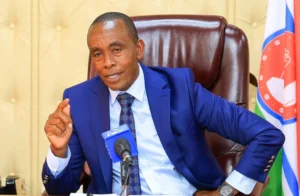
The demolition of Kiambu Governor Kimani Wamatangi’s business near Nyayo Stadium caused public attention. Authorities confirmed the action aligns with preparations for the 2027 Africa Cup of Nations (AFCON).
The site housed a car wash, carpet cleaning services, and a small restaurant. Bulldozers and police officers executed the demolition overnight to avoid public disruption.
The Demolition Event
The operation occurred in the early hours of January 14, 2026. Bulldozers and excavators cleared the premises in under six hours.
Governor Wamatangi’s business occupied prime land along Douglas Wakiihuri Road. Local residents reported seeing police and heavy machinery surrounding the area.
Authorities stated the demolition followed repeated warnings to vacate the premises. Traders along the railway corridor had received notices months earlier.
Businesses had obstructed access along the railway line, creating safety and transport concerns. Officials emphasized the need to clear encroachments for public infrastructure projects.
The demolition coincided with Nairobi’s plans to upgrade transport corridors. KRC identified the site as critical for commuter and tournament traffic.
Kenya Railways’ Justification
Kenya Railways Corporation stated the action supports railway corridor development. Officials said the cleared area will host new transport infrastructure for AFCON.
A new railway station will operate near Nyayo Stadium. The expansion aims to connect Nairobi Central Station, Talanta Sports City, and other key locations.
The government highlighted commuter rail improvements as vital for managing crowds during the tournament. Rail networks will ease travel for fans, officials, and media personnel.
Authorities emphasized the demolition followed legal procedures and repeated warnings. The railway line remains a public reserve with strict regulations on encroachment.
Traders had limited options to relocate due to the short timeline. Officials urged business owners to comply with notices to avoid further conflicts.
AFCON Infrastructure Requirements
Hosting AFCON requires rapid, safe transport for large crowds. Stadiums and fan zones need direct rail and road connectivity.
Matches will take place at Kasarani Stadium, Talanta Sports City, and Nyayo National Stadium. Efficient transport ensures minimal congestion and timely movement of officials and fans.
Rail improvements include new stations, upgraded tracks, and spur lines linking central and peripheral venues. These developments increase public safety and operational efficiency.
Officials noted the railway corridor serves both tournament and long-term urban transport needs. The cleared area near Nyayo Stadium forms part of a wider strategic plan.
Rail authorities stated they must remove obstructions to meet strict project deadlines. Delays could compromise both tournament schedules and urban mobility goals.
Legal and Political Context
Governor Wamatangi claimed the property held a valid lease for over twenty years. He argued the demolition violated constitutional protections on property rights.
Court orders existed to prevent interference with the premises. Despite these orders, the demolition proceeded, creating controversy and legal debates.
Some political figures labeled the demolition as politically motivated. Wamatangi described the move as an attack on his public image and authority.
Authorities maintain that infrastructure needs outweigh individual claims. The railway corridor remains classified as public land, requiring clearance for development.
Legal proceedings will determine whether the demolition complied with proper administrative procedures. AFCON-related timelines do not exempt agencies from observing lawful protocols.
The AFCON Link Explained
The demolition ties directly to AFCON transport preparations. Officials must ensure stadiums and fan zones remain accessible for large crowds.
Rail improvements allow safer, faster movement of fans, players, and media. The cleared corridor will connect Nyayo Stadium to Nairobi Central Station and surrounding venues.
Officials emphasize that delaying or ignoring encroachments risks disrupting tournament operations. The infrastructure supports both short-term AFCON needs and long-term urban transport.
Rail authorities had issued multiple warnings before taking action. The urgency increased as the tournament approaches and construction timelines shrink.
The site’s strategic location near Nyayo Stadium made it unavoidable for clearance. Any delay would compromise commuter rail connectivity and operational readiness.
What Next?
The demolition of Wamatangi’s business serves a specific, practical purpose. AFCON preparations, especially railway corridor upgrades, made the action necessary.
Railway authorities insist they followed notice procedures while prioritizing safety and accessibility. Businesses and residents along the line must comply to avoid further disruptions.
The controversy highlights the tension between urban development and private property claims. Legal and political disputes will continue, but the AFCON connection remains clear.
Infrastructure projects like these illustrate the balance required between rapid urban planning and respecting property rights. Kenya’s transport improvements aim to ensure smooth tournament operations and legacy benefits for citizens.
About The Author
