
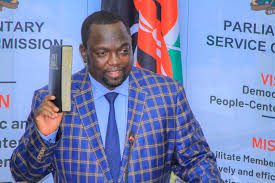
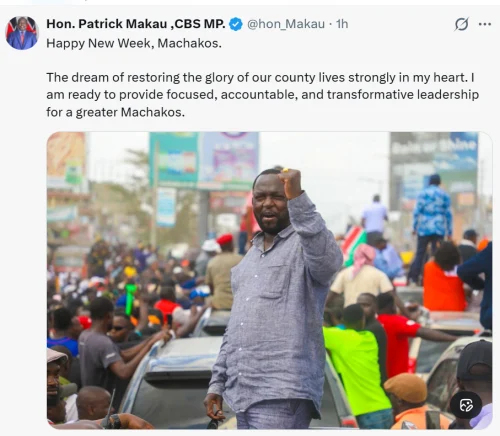
Patrick Makau has openly signaled interest in running for the Machakos governor seat in the 2027 general election, a move that could trigger an intense political contest within his own party and reshape the county’s leadership race. The Mavoko Member of Parliament dropped the hint through his X account on Monday, February 16, 2026, where he framed his intention around what he called a mission to restore Machakos County’s former strength and performance.
Makau did not hedge his language. He spoke in direct, leadership-focused terms and positioned himself as ready for executive responsibility at county level. His message targeted Machakos residents and framed the possible bid as a service-driven ambition rather than a power grab.
He wrote that the dream of restoring the county’s glory remains strong in his heart and added that he stands ready to offer focused, accountable, and transformative leadership. That wording matters. It shows early campaign-style positioning: reform, accountability, transformation. Politicians use those three pillars when they want to contrast themselves with a sitting administration without launching a direct attack yet.
Social Media Message Signals Strategic Timing
Makau chose social media, not a rally or press conference, to float the idea. That choice allows flexibility. It tests public reaction without locking him into a formal declaration. If backlash grows, he can soften the stance later. If support builds, he can escalate into a full campaign launch.
Early signals like this often serve one purpose: measure political temperature. Serious candidates rarely wake up and post ambition randomly. They calculate timing, wording, and audience response. His statement reads like a soft launch, not a casual thought.
The phrase “greater Machakos” also suggests a campaign narrative already in development. Campaigns run on themes, not slogans alone. Restoration and greatness messaging usually points to a platform built around governance performance, service delivery, and fiscal control.
Direct Collision Course With Sitting Governor
If Makau runs, he will not enter an empty field. He will face the incumbent governor, Wavinya Ndeti, who holds the seat as a first-term county boss and will almost certainly defend it in 2027. Incumbents rarely step aside voluntarily. That sets up a high-friction contest.
An incumbent carries structural advantages: visibility, control of county agenda, development project launches, and administrative networks. Challengers carry a different weapon: criticism and alternative vision. Makau appears to be positioning himself for the second role.
This potential race becomes more complicated because both leaders sit in the same political outfit the Wiper Patriotic Movement.
Internal Party Battle Likely
Both Makau and Wavinya belong to the party led by former Vice President Kalonzo Musyoka. That means the first real battle will not happen at the general election. It will happen during party nominations.
Party primaries in Kenya often turn more brutal than the general race because they split loyal voter bases and local networks. If Makau pushes forward, he must defeat a sitting governor inside the party before he even reaches the ballot.
That scenario produces three possible outcomes:
He wins the party ticket and unseats the incumbent internally.
He loses the ticket and drops the bid.
He loses the ticket and defects to another party or runs as an independent.
Right now, he has not named the party vehicle he would use if he runs. That omission looks deliberate. It keeps his options open and gives him negotiation leverage.
Makau’s Political Base and Experience
Makau has represented Mavoko Constituency since 2013. That gives him over a decade of parliamentary experience by the time the 2027 election arrives. Longevity builds name recognition, grassroots structures, and donor relationships all critical for a countywide race.
However, constituency success does not automatically convert into countywide victory. A governor race requires broader geographic appeal, cross-ward alliances, and coalition building beyond a single stronghold. Many MPs overestimate how far their local base can carry them. Smart ones start expanding networks years before declaring.
His message about accountability and transformation suggests he plans to campaign on governance performance rather than identity politics alone. That approach can work but only if backed by specific policy proposals later. Vague reform language wins attention, not elections.
What He Did Not Say Matters
Makau did not release a policy outline. He did not name campaign pillars. He did not present data on county performance gaps. He did not declare a campaign team. That tells you this remains a positioning phase, not an operational campaign yet.
He also avoided attacking the current governor directly. That restraint shows political discipline. Early direct attacks can close party doors fast. Soft contrast keeps alliances intact while still signaling ambition.
Early Signal, Real Consequences
Even a hint of a governor bid changes local political math. Allies start choosing sides quietly. Donors begin exploratory talks. Opponents begin opposition research. Party leadership starts risk calculations about nomination fallout.
Whether Makau confirms a full bid later or not, the signal already triggered strategic movement inside Machakos politics. Sitting leaders now know a potential challenger has stepped into the conversation. Supporters now know he feels ready for a higher seat.
Bottom line: this was not a random motivational post. It was a controlled political marker. If he follows through, Machakos will see a serious nomination fight long before 2027. If he doesn’t, then this still served as a power test and in politics, power tests never go to waste.
About The Author
